
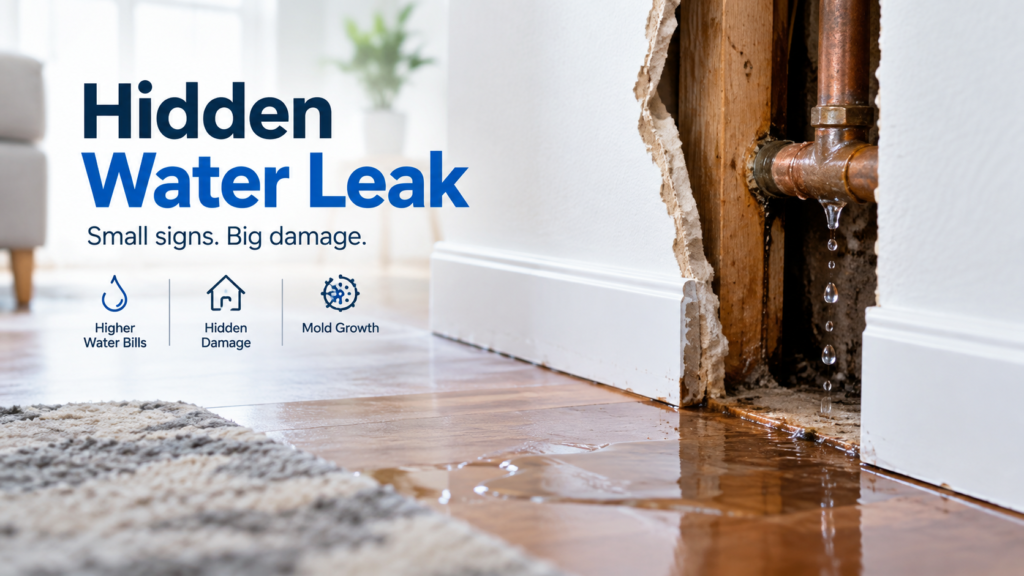
The water bill shows up and it’s higher. Not a dollar or two higher, actually higher, the kind of jump that makes you squint at the number a second time because surely you read it wrong. You didn’t. Nobody in the house has changed anything, same showers, same laundry, no pool getting filled in the backyard, so where exactly is this extra money going every month?
An unexplained water bill increase like this is usually one of the first signs of a hidden water leak, and it’s often the one that sends people looking for answers in the first place. A lot of homeowners land here after running through the obvious explanations first. Maybe the water company made an error, maybe it’s a fluke, maybe it corrects itself next month. Sometimes that’s true. More often, though, there’s a water leak with no visible source somewhere in the house that hasn’t made itself known yet, at least not in any way you’d notice without really looking.
Here’s the thing about hidden leaks. They’re hidden, obviously, but that doesn’t mean invisible forever. Most of them leave some kind of trace before you’d ever actually see water, a smell, a sound of running water at night when the house is quiet, a spot on the ceiling that’s a little darker than it should be. The signs of a hidden water leak are usually there well before the damage is. People just don’t know how to connect them.
What Causes a Leak Like This in the First Place
Worth a quick detour before the list, since knowing the cause helps explain why these things go unnoticed for so long. A hidden leak almost never comes out of nowhere. It usually traces back to one of these.
- Old galvanized pipe corroding from the inside, slowly, which means by the time it actually fails you’ve already had years of weakening leading up to it
- Copper lines developing pinhole leaks, more common in homes with certain water chemistry than people realize
- Slab leaks, where a line running under the foundation cracks, brutal to catch early because there’s a literal slab of concrete between you and the problem
- Fittings loosening gradually at joints and connection points
- Ground movement, shifting, freezing, thawing, all of it putting stress on buried pipe over time
- Worn fixtures, something as simple as a toilet flapper or a water heater connection dripping steadily for longer than anyone noticed
None of these start loud. They start quiet and stay quiet until they don’t.
12 Things Worth Paying Attention To
These are the signs that tend to show up before a hidden leak becomes an obvious one, some of them easy to notice right away, others the kind of thing you’d only catch if you knew to look for it.
1. Unexplained Water Bill Increase
Start here because this is where most people start, whether they mean to or not. If your unexplained water bill increase can’t be traced to anything you’ve actually changed, that’s not nothing. It’s often the only early clue a hidden water leak gives you, at least at first.
2. Water Meter Keeps Running
Simple test. Turn off literally everything in the house that uses water. Every faucet, the dishwasher, the ice maker, all of it. Then walk outside and look at the meter. Still moving? That’s water going somewhere it shouldn’t. A water meter that keeps running with nothing on is about the closest thing to proof you’ll get without calling in a professional with actual equipment.
3. Sound of Running Water
You’re lying in bed and you hear it, water moving somewhere in the walls, and at first you think it’s the neighbor’s plumbing or maybe just the house doing its normal settling thing. It’s usually not. A sound of running water with no clear source, especially that running water sound in walls specifically, tends to mean there’s an active leak somewhere close by.
4. Low Water Pressure
Not one faucet being weak. The whole house, gradually, over weeks or months, losing pressure in a way that’s hard to pin down because it happened slowly enough that you adjusted without noticing. That kind of low water pressure drop can mean water’s escaping the line before it even gets to your fixtures.
5. Damp Walls or Floors
Soft spots. Cool-to-the-touch spots. Areas near a bathroom or kitchen wall that just feel wrong somehow when you put your hand on them, even though there’s no visible water anywhere. Damp walls or floors usually mean moisture has already worked its way into the structure, and it got there before you noticed anything.
6. Water Stains on Ceilings
These don’t appear overnight, ever. A yellowish or brownish ring on the ceiling, especially under a bathroom, means a slow drip has probably been going for weeks already by the time it’s visible from below. Water stains on ceilings are basically a leak announcing itself after the fact.
7. Musty Odors
This one’s underrated. Musty odors that won’t go away no matter how much you clean, air out the room, light a candle, whatever, are often the very first sign, before anything else on this list shows up. Your nose catches it before your eyes do. Worth trusting that.
8. Mold Growth
Mold growth needs sustained moisture, so if you find it somewhere that has no business being wet, behind the dresser, along a baseboard, inside a closet you never open, something’s feeding it. Usually a water leak with no visible source sitting just out of sight.
9. Warm Areas on the Floor
Surprises almost everyone the first time. A patch of floor that’s noticeably warmer than the rest, for no obvious reason, can point to a leaking hot water line running underneath the slab. More common in homes with radiant heat, but it happens elsewhere too.
10. Cracks Near the Foundation
Water that escapes underground erodes the soil holding your foundation steady, and the house shifts in response, however slightly. New cracks near the foundation, or old ones getting wider, are worth paying attention to, particularly if you’re also seeing a couple of the other signs on this list.
11. Wet Spots Outdoors
A patch of yard that never quite dries out even during a stretch with no rain. Grass that’s suspiciously greener in one spot than everywhere else around it. Easy to walk right past these. A lot of people do, for months, before realizing it connects to the plumbing.
12. Repeated Plumbing Problems
The same clog, the same pressure dip, the same minor leak, all showing up again in roughly the same part of the house. That’s not bad luck. Repeated plumbing problems concentrated in one area usually mean there’s a bigger leak putting ongoing stress on that section of pipe.
When These Signs Mean It’s Time to Call Someone
Two or three of these at once, stop guessing and get it looked at. That’s really the whole rule. Leaks don’t fix themselves, they just get more expensive the longer they run, and most of the damage happens quietly in the background while you’re still deciding whether it’s worth the call.
NLP Plumbing handles hidden water leak detection throughout the Denver area, using pressure testing and acoustic equipment to find the actual source before anyone starts cutting into drywall or digging up the yard. If the bill’s been climbing or something about the house has just felt a little off, that’s reason enough to get it checked.
How the Signs Tend to Cluster
Rarely does a hidden leak show up as just one symptom in isolation. Usually it’s two or three together, and which ones show up together tells you roughly where to look.
| What You’re Noticing | What It Usually Means |
| High water bill leak + meter still running | Active leak on the main line or a fixture |
| Musty odors + mold growth | Leak that’s been going a while, likely behind a wall |
| Water stains on ceilings + damp walls | Leak in plumbing above or inside that wall cavity |
| Warm areas on the floor, no other cause | Hot water line leaking under the slab |
| Wet spots outdoors + cracks near the foundation | Underground line leaking, affecting the soil |
| Low water pressure + repeated plumbing problems | Leak reducing flow somewhere along the main supply |
What Happens If You Just Don’t Deal With It
Putting things off may not seem like such a big deal at the time, mainly due to the lack of an obvious force like water flooding from a burst pipe, pushing you into action. However, leaking pipes often result in damage in a number of specific ways that don’t become any less expensive the longer one waits.
First, the building itself is affected by the damage. Wood beams and wood flooring become weakened by constant moisture, while a foundation that is experiencing water leakage without any apparent reason will require structural repairs when the problem is eventually located.
Then there’s mold. Once mold growth gets started it doesn’t stay small for long, and it’s not just a cosmetic issue, it genuinely affects the air quality everyone in the house is breathing.
And then there’s just the money. A leak running unchecked for months can waste an enormous amount of water, and that shows up as a high water bill leak that keeps climbing every single billing cycle until somebody actually finds and fixes the source.
How a Plumber Actually Finds a Hidden Leak
Not guesswork, in case that’s a concern. There’s a process.
- Water meter test first, confirming water’s moving when it shouldn’t be
- Pressure testing to narrow things down to roughly where along the system the leak sits
- Acoustic equipment that picks up the actual sound of escaping water, even through walls or underground, this is usually how that running water sound in walls gets traced to its exact point
- Thermal imaging to catch temperature differences that indicate moisture movement behind surfaces
- Repair, finally, targeted to just the section that actually needs it rather than opening up more than necessary
Non invasive, mostly. Nobody wants their walls torn apart to find a leak that turns out to be six inches from where they guessed.
If This Sounds Familiar, Don’t Sit on It
A rising bill. A smell that won’t quit. Water running somewhere when nothing’s turned on. These aren’t nothing, and waiting another billing cycle to see if it “sorts itself out” almost never pays off.
NLP Plumbing provides leak detection across Denver and the surrounding area, using the same pressure, acoustic, and thermal methods above to track down the source and fix it properly the first time. Call and get it checked before it turns into something bigger than it needed to be.
Frequently Asked Questions
What are the first signs of a hidden water leak?
Usually an unexplained jump in the water bill, and a meter that keeps running even with every fixture in the house turned off.
Can a water leak happen with no visible water?
Yes, pretty often actually. A leak behind a wall, under flooring, or beneath the foundation can run for a long time before any water actually becomes visible anywhere.
How can I tell if my high water bill is from a leak?
Check the meter with everything off. If it’s still moving, or the bill keeps climbing with no real change in your usage, a leak is the likely explanation.
Is low water pressure a sign of a leak?
It can be, especially if the drop happened gradually across the whole house rather than being limited to one tap.
How do plumbers detect hidden water leaks without digging up the yard or walls?
Mostly through pressure testing, acoustic listening equipment, and thermal imaging, all of which locate the leak before any actual repair work starts.